
Be Like Taavet
A Tech Titan from Tartu Challenges Europe to Dream Bigger

HELSINKI, Nov 20 - In the high-stakes world of European venture capital, few names carry as much weight as Taavet Hinrikus. From his days as the first employee at Skype to co-founding the fintech giant Wise, Hinrikus has moved from being a participant in the ecosystem to one of its most influential architects.
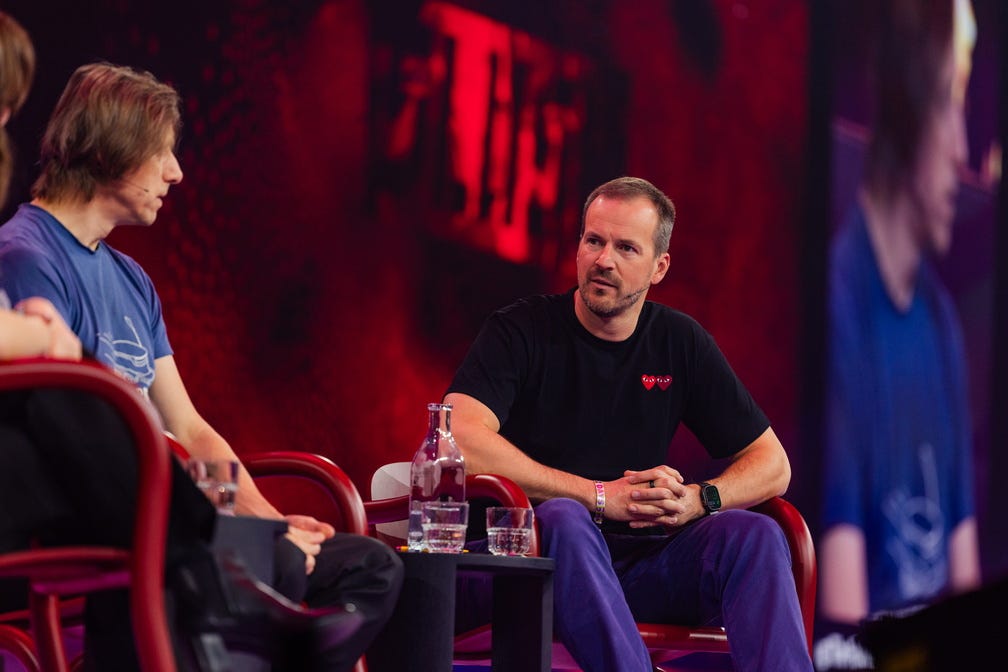
Photo by Vertti Luoma / Slush
Speaking on stage at the Slush tech conference in Helsinki, Hinrikus, now a partner at the venture firm Plural, laid out a vision for a European tech sector that is no longer content with being second-best. His message arrived alongside the 2025 State of European Tech report by Atomico, which paints a picture of an ecosystem at a “turning point”.
The “European Awakening”
The annual Atomico report declared 2025 as a year of “awakening,” with the European tech sector now worth nearly $4 trillion — representing 15% of the continent’s GDP. Optimism has surged to its highest level since 2021, with 50% of founders and investors feeling more bullish than they were a year ago.
However, this growth faces a stark “growth gap”. While Europe now rivals the U.S. in startup creation, it lags massively in scaling them. For Hinrikus, this isn’t just a funding issue; it’s a mindset shift.
The Demystification of Success
For Hinrikus, the biggest shift in the last twenty years is the “demystification” of building a world-class company. He recalls a time when building a global tech giant felt like a feat reserved for Silicon Valley.
“Twenty years ago, we were looking at America, looking at Silicon Valley, and there was this magical company called Google. We in Europe should not even think about it.”
That changed with Skype. Hinrikus realised that the founders were not mythological figures. “Niklas and Janus are just humans. There is nothing special about [them]. They’re just dudes like me,” he said. This realization sparked a chain reaction: “If they can build a global company, then I can build a global company.”
Today, he sees that same realisation spreading. “Now every boy and girl in Estonia can think, ‘Look at Taavet, he’s just an average dude from Tartu. If he can do it, then I can do it.’”
“Cathedral Thinking” and the 100-Hour Week
While Hinrikus champions the “average dude” approachability, his expectations for founders are anything but average. When asked about the “Nordic dream” of work-life balance, Hinrikus was blunt:
“If we’re talking about building life-changing companies... there is no other way of doing it than working 100 hours a week,” Hinrikus stated.
He advocates for “Cathedral Thinking” — starting projects today that may take generations to realise. This aligns with a broader sectoral shift in Europe: Deep Tech and AI now capture 36% of all venture capital, up from 19% in 2021. Plural’s portfolio reflects this, with bets on companies like:
Helsing: A defence AI company (part of a $1.6 billion surge in European defence tech).
Proxima Fusion: Working on nuclear fusion power plants.
“I’m hoping they’re going to build really big businesses, not just like Skype and Wise,” Hinrikus added.
The Funding Gap and the 11-Minute Warning
Despite the optimism, Atomico’s data reveals a “decisive decade” ahead. The U.S. remains “supremely dominant” in AI investment, on track for $146 billion in 2025 compared to Europe’s $14 billion. To close this, the report argues Europe must mobilize “patient capital” from pension funds—a $210 billion opportunity if European allocations matched US levels.
Hinrikus maintains a sobering perspective on this urgency. When asked about his reading habits, he cited a book on nuclear war scenarios. “If a nuclear war starts, we’re all going to be [finished] in about 11 minutes,” he said. This awareness fuels his advice to founders to operate on a three-year horizon:
“What if we think about, ‘If I have three years to live, what would I do?’... You can achieve something work-wise if you want to.”
Unanswered Questions
While the building blocks are in place, structural gaps remain:
Regulatory Friction: 70% of founders still find Europe’s operating environment too restrictive.
Talent Brain Drain: 18% of repeat founders now choose to incorporate in the US, up from 10% in 2016.
Path to the Trillion-Euro Company: Will Europe’s “sovereignty tech” be enough to produce its first trillion-dollar champion?
Hinrikus’s message at Slush was clear: the path from Tartu to the top is open – provided Europe can match its world-class talent with the courage to take bold, “cathedral-sized” risks.
EU-INC: The 28th Regime
EU-INC is a community-driven proposal featured in the 2025 State of European Tech report that calls for a single, pan-European legal entity for startups. Aiming to end the fragmentation of 27 different national legal systems, it is often referred to as the “28th Regime”—a standardised framework that exists alongside national laws as an optional alternative.
Key Pillars of the Proposal
Digital-First Incorporation: Enables founders to incorporate digitally in English and begin operations across all EU borders within 48 hours.
EU-REGISTRY & DASHBOARD: A centralised EU-level registry and management system to standardise company legal status and transparency.
EU-ESOP: A unified Employee Share Option Plan to help startups attract and retain talent across borders without navigating conflicting national tax and labor laws.
EU-FAST: A standardised, open-source investment instrument (similar to the U.S. SAFE) to simplify and speed up pan-European funding rounds.
The Core Objective
The goal is to create a “Delaware C-Corp” equivalent for Europe, reducing the administrative burden that currently sees 18% of senior European founders choosing to incorporate in the U.S. to access simpler scaling and capital. By providing a single rulebook, EU-INC aims to keep European innovation, talent, and capital within the continent.