
CARMEN KIVISILD: Are hackathons for children?
The full story of organising a hackathon to boost your product development.
When I was inviting people to our hackathon, one guy told me he wasn’t coming because it was going to be a bunch of children. I said okay with a laughing emoji and moved on. But it made me realise that most people have no idea what a hackathon actually is, who shows up, or what it can do for a company.
So let me tell you the whole story of ours. The insane rebuild, the chaos, the wins, and why organising a hackathon was the single best thing we did this year (I know it’s only March). And I hope that after reading this, you’ll stop whatever you’re currently doing and go participate in one. Or even better, organise it yourself and invite us to co-organise it with you.
Before our first hackathon, we rebuilt everything in just a few weeks. But that’s another story.
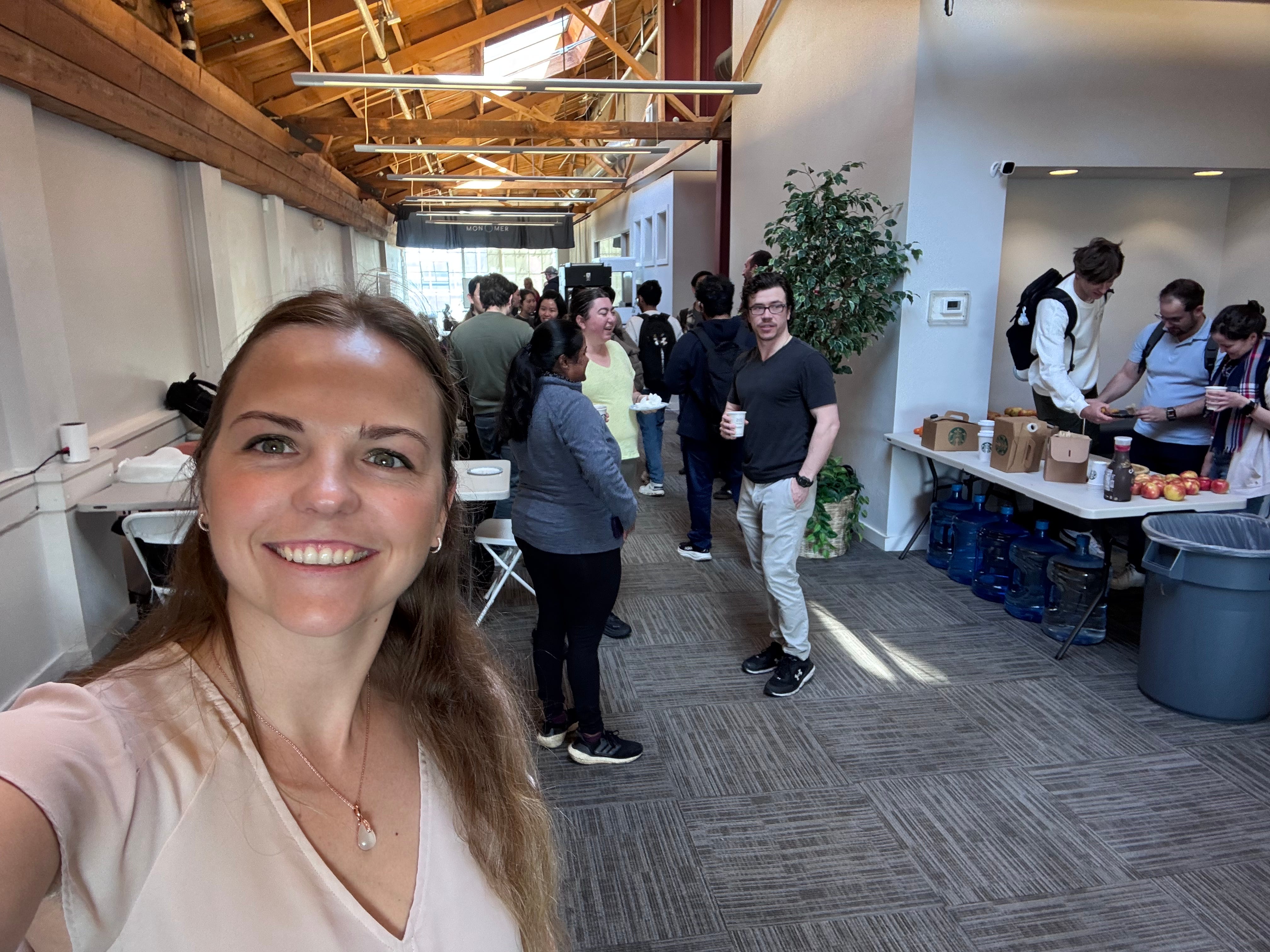
Hackathon day
We reached out directly to over 500 people. More than 150 registered, and we had to stop the waitlist because we could only fit about 50. We already had 75 registered, and another 75 on the waitlist. Out of those, about 43 people actually came for a full 24 hours of building, and the gender balance was roughly 50/50, which I was very happy about.
We were the opening act. We gathered all the people and said, “Hey, this is Elnora. Here is your API key. You can use the CLI or MCP, which I built, or the regular UI, go and knock yourself out.”
While I was registering people on the platform and sorting out everyone’s API keys, Risto was checking the agent responses and behaviour as the first builders started testing Elnora, and found several bugs, like the agent truncating responses so the user could only see the top half of the protocol. He literally had to fix and deploy on the production platform at the same time when people were already on it. I wasn’t sure if we were going to make it, really. My heart wanted to jump out of my chest.
But we did. Elnora started sending out full responses, and builders loved the agent. It was just incredible.
The tracks
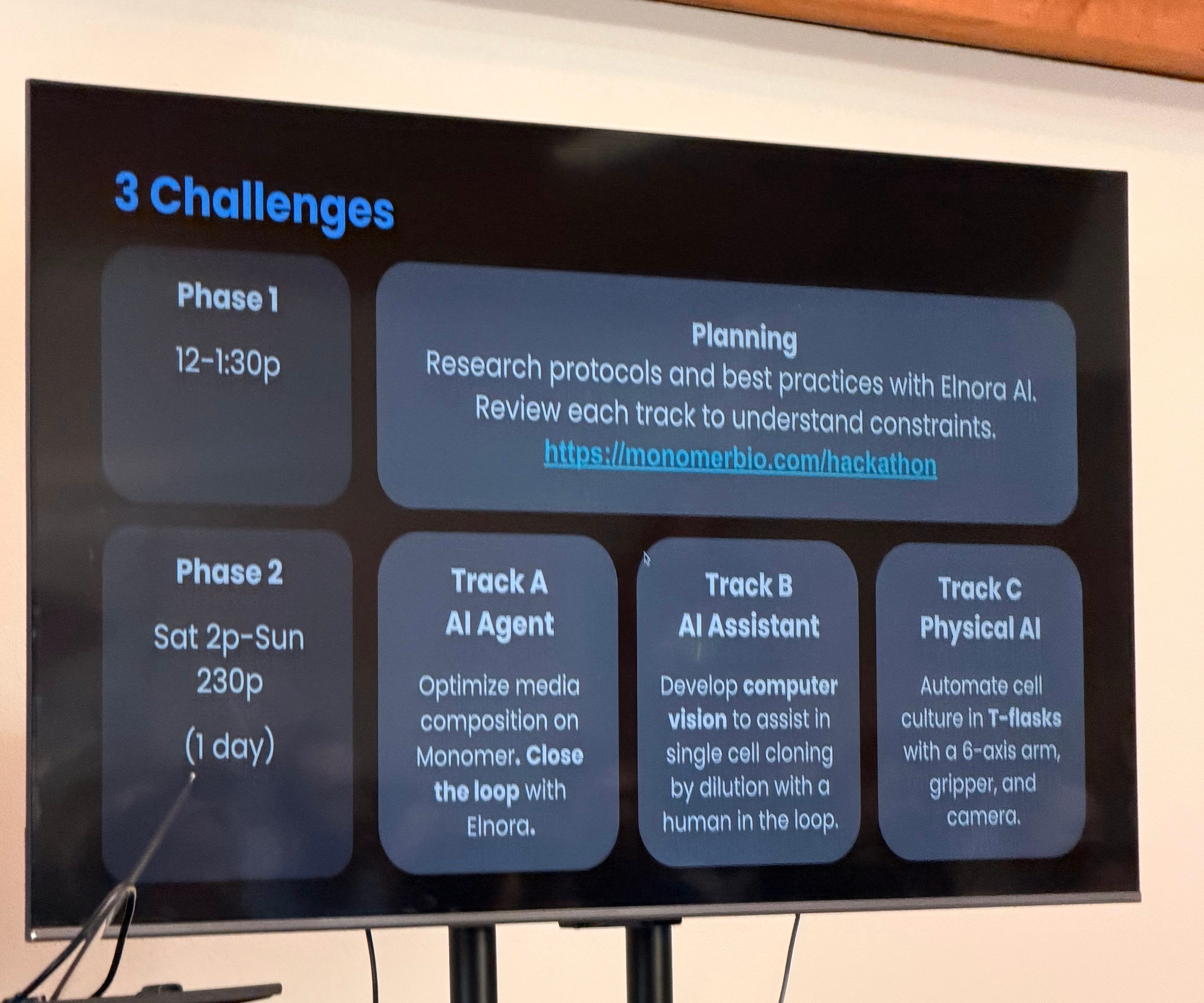
We had three tracks. Track A was to onboard a new cell line and use Elnora to generate a media composition that would maximise the delta, meaning the difference between how many cells you started with and how many you ended up with. We were using a bacterial cell line that’s one of the fastest growing on Earth; it doubles every 10 minutes, so you see results very quickly. The job was to use Elnora to generate lab protocols, send them to Monomer’s robotic lab, receive the results, feed them back to Elnora, and optimise. As many rounds as they could to get the best media composition.
Track B was to get a single cell on a well, which sounds trivial, but it’s not at all. You have a 96-well plate, and in every well, you want just one single cell, so you can start growing a colony; you don’t want two different cells as the starters of colonies. For this track, they used beads instead of actual cells to simplify the process.
Track C got a robotic arm and needed to program it to perform actual bench work: grab cell flasks from the incubator, place them on the bench, image them, change the media, passage the cells, and return them. Basically, automate an entire day of manual lab work.
Officially, Elnora was only part of Track A. But in the end, we had 6 teams out of 7 incorporate Elnora in their workflow, which was not something we expected at all.
The winning team
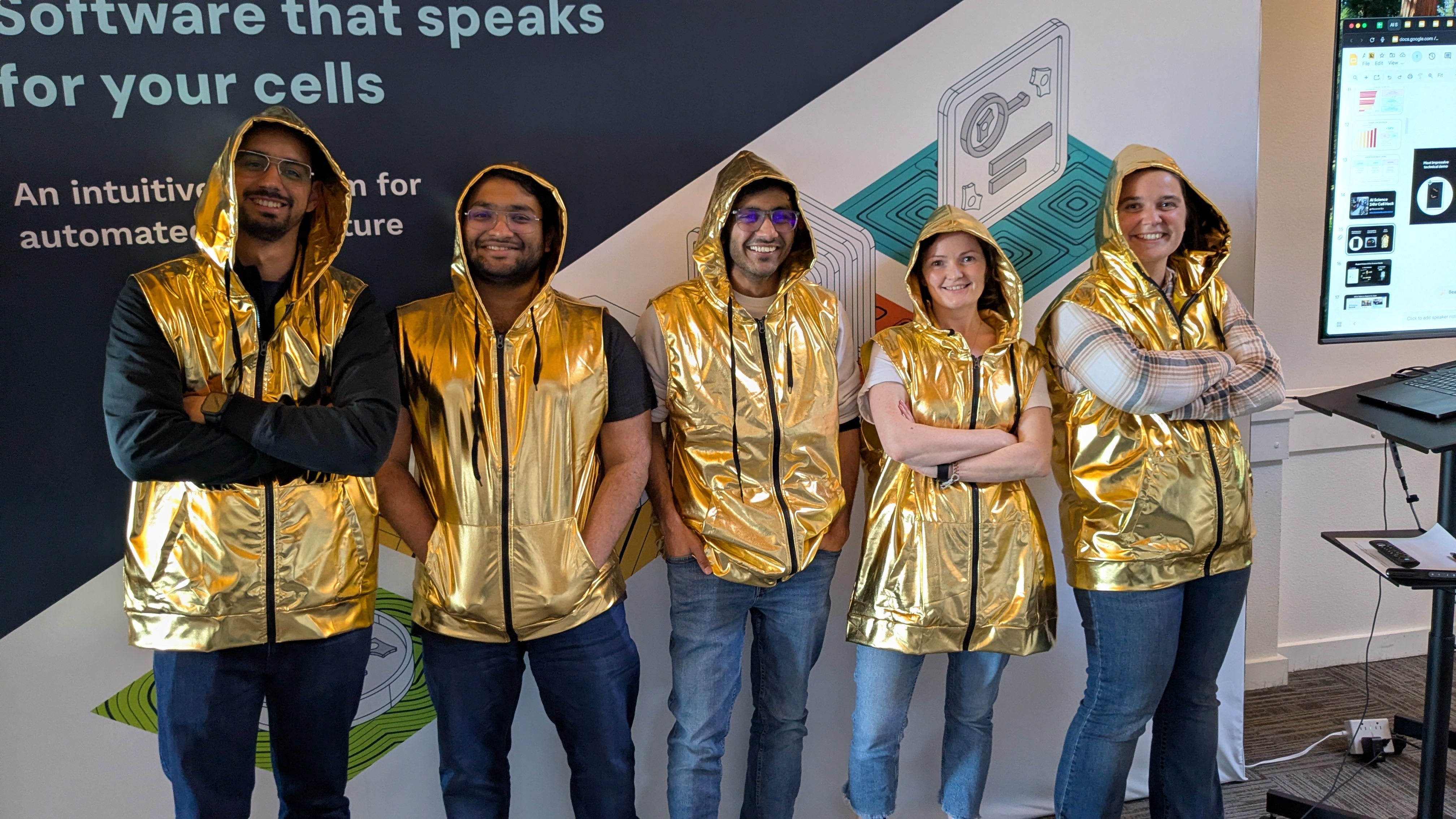
The winning team was a robotic arm team, and they built a whole closed loop. The robot took out the cells, imaged them, and confluency was at 70%, and sent that information to Elnora. Elnora said, “Looks like cells are ready for splitting. Here is a lab protocol for you to do that.” The robot goes, does the work, and puts the cells back.
Then Elnora says, “Okay, let’s take another look at those cells.” The robot takes them out, images them, and sends back: 5% confluence. Then Elnora says, “No, we can’t split those cells, but something seems off because we went from 70% to 5%, so we need to change something in the media.”
When I saw that demo, I was just grasping air. I could not believe it. The way they connected Elnora as an agent to the robot performing those lab protocols was just genius. It was so so so beautiful. I loved it so much. They were everyone’s favorite team, and they won.
Both Track A teams managed to increase the growth delta compared to the baseline media, which was the whole point. One of them also won the best demo award for building an app that anyone could scan a QR code to see the experiment results in real time.
One of those teams also ran Elnora and Claude side by side on the same task, and Elnora kicked Claude’s ass. Claude is my favorite, don’t get me wrong, but because Elnora has so many specialised tools and skills that Claude doesn’t have, it performs way better on science tasks. That was really cool to see.
Most Scientists Don’t Code
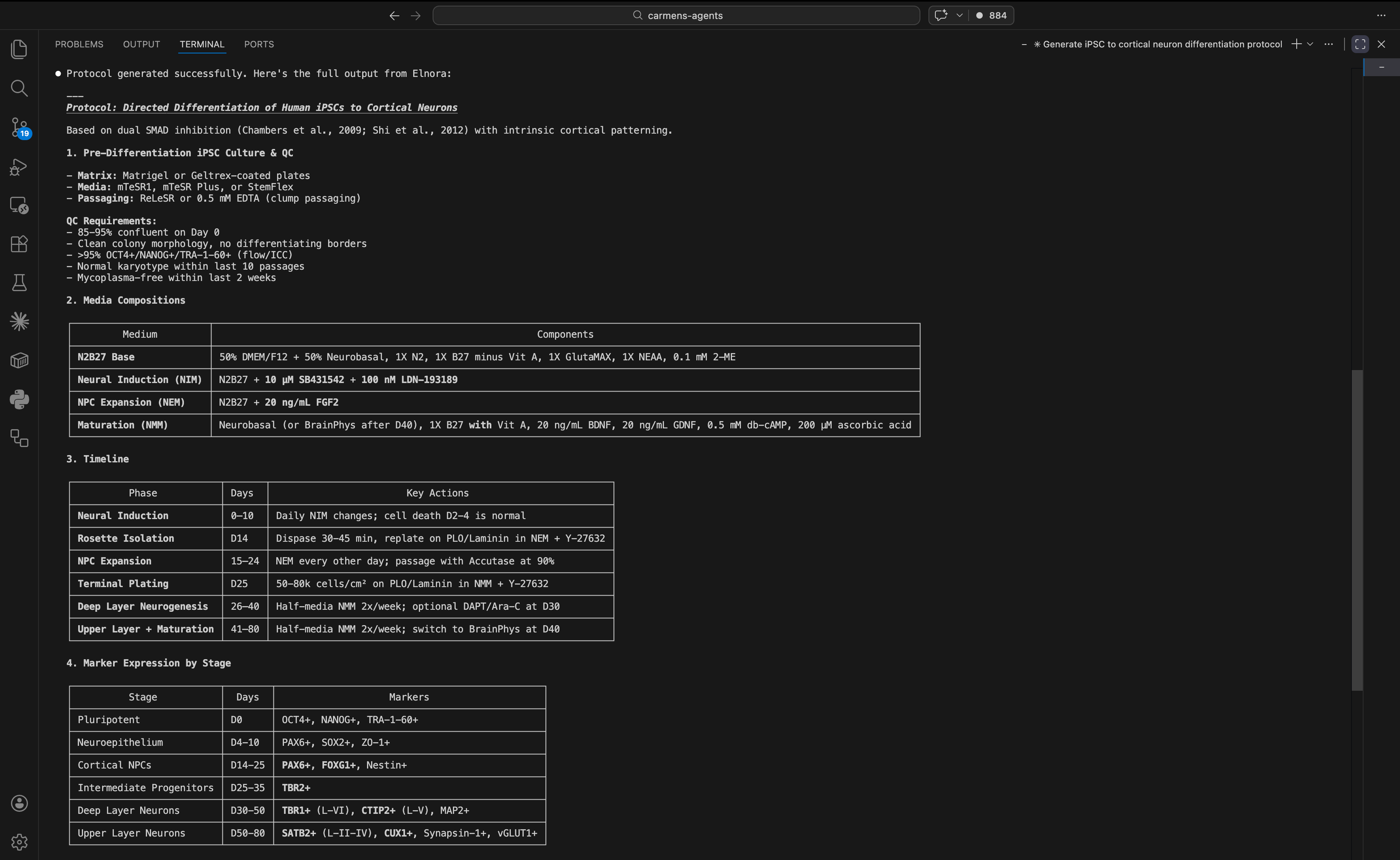
Many biologists who had never coded before came to the hackathon. We have a UI, but my favorite way to use Elnora is via the CLI. When biologists arrived, and I said, “Let’s start working on lab protocols,” they asked how. I explained that Elnora is a CLI tool, so you’d need another coding agent, such as Claude, Codex, or Gemini, to orchestrate it.
And people said they didn’t have a coding agent. I was shocked. How do you do your everyday job without one? I genuinely cannot remember life before coding agents. I use Claude for everything, and Elnora for science work. I just assumed everyone had Cursor, Codex, Gemini, or Claude. Totally wrong assumption. 90% of scientists at our hackathon had never coded and had no tools, let alone subscriptions.
Before I could even get them started on Elnora, I had to teach them the fundamentals first. What a terminal is, what VS Code is, what an API key is, and why you treat it like a secret. I love doing this because I’m an ex-scientist myself, and I understand exactly where they were coming from. But it was a wake-up call.
Then there was the communication gap. Using agents isn’t natural to humans. When I talk to my best friend Maria, I say, “Yesterday I went to a store, and I...” and she understands me immediately because she’s known me for 15 years, she has context. An AI agent straight out of the box doesn’t know you; it has exchanged a couple of words with you, and that’s it, no experience, no context. So you have to be very clear and straightforward. That’s a skill most people haven’t developed yet.
The biggest learning from the whole hackathon was that I’m living in a bubble, and a lot of people aren’t in the same bubble. I assumed the whole world keeps up with every new AI tool. They don’t. Two and a half years ago, I was that person too, a regular scientist sitting behind the bench all day doing traditional science in academia. The initial learning curve is sharp, but after a month or two, I was already at a top level. It’s not that I’m the smartest person on earth, definitely not, but I had an amazing teacher in Risto, and I read a lot. Every day, I try to read at least one blog post about agents or AI tooling, and when I find something interesting, I try to implement it immediately. That’s the fastest way to learn.
And now it’s my personal mission to help scientists start coding.
By coding, I don’t mean writing Python. I mean using English as a coding language.
What we’re changing
The biggest product takeaway was clear: we need to eliminate the need for another coding agent to orchestrate Elnora. That was just too hard for participants. If 90% of your users don’t have a coding agent and have never used a terminal, you can’t make that a prerequisite. So that’s our number one focus now — making Elnora something anyone can use without needing to set up Claude or Cursor first.
We also got feature requests I didn’t think of myself. One person said, “Elnora, draw me a graph.” Elnora can’t draw, but it said, “I can’t do it, but I’ll give you code instead. If you copy-paste that code on that website, you’ll see my drawing.” The person did it, and it worked. I guess we are now teaching Elnora how to draw graphs.
Why you should organise a hackathon
Well, after you heard my story, do you still think that hackathons are for children? Let me tell you who the people were in the room going through all this I just shared with you.
Working professionals from pharmaceutical companies with hundreds of thousands of employees, scientists who have been running labs for 20 years, AI engineers, robotics people, people who code every day, and people who have never coded before. I’m 34, and most people I see at hackathons are around my age or older. These are people with real jobs and real expertise who came because they want to experience what it feels like to have completely free hands and a free mind to create anything.
What makes a hackathon special is exactly the mix. You get a bunch of people who are similar to you but also completely different at the same time, and you combine all that expertise into one team that in a regular environment would probably collapse, but in a hackathon environment is magnetic. People just pull toward each other and tackle problems together. It doesn’t matter if you’re a CEO, an associate, or an intern; everyone is mixed, there’s no space for ego, and the only rule is that there are no rules.
So why should you, as a company, organise one?
We rolled out a brand new version of Elnora days before the hackathon and gave it to real people who are not our friends, and watching how they actually use your product is worth more than months of internal testing. The day after our hackathon, our website views were 5-6 times higher than usual, all organic, all from real people. We had pharmaceutical companies in the room, and the conversation immediately turned into “hey, you just used Elnora successfully, what about rolling this out at your company?” Even though we weren’t actively recruiting, people reached out saying they wanted to work for us. And by organising together with Monomer Bio, we proved we can collaborate on shared projects with shared clients going forward.
You don’t need a massive budget or to be a big company. You need a real challenge from your work, not something made up; a venue with tables and good wifi; food and coffee for people who will stay overnight; and a group of curious people who want to build something together. Find a partner company that complements what you do, set up a Luma event, and market it hard. People’s attention spans are short, so you need to cast a wide net.
And if you want to organise a bio-hackathon, an AI hackathon, or anything where agents, science, and building things come together, reach out to me. I want to help you do it. I want to be there when your participants have that moment where they see something they built actually work, and they can’t believe it.
My best friend Maria texted me the other day saying that coding gives her higher dopamine than scrolling TikTok. You get addicted to it. It’s so rewarding. Go do it. If you don’t know how, participate in a hackathon, find people who know how to build agents and can teach you, and then you can do it too.
So hackathons are definitely not for children. They’re for people who are ready to build something that 24 hours ago was someone’s wildest dream.
Carmen Kivisild is CEO and co-founder of Elnora AI, building AI agents for preclinical lab protocol generation in pharma and life sciences. If you want to co-organise a hackathon or talk about agents for science, reach out at carmen.kivisild@elnora.ai.