
Commissioner: Europe’s stability a shield against global volatility, Baltics an innovation beacon
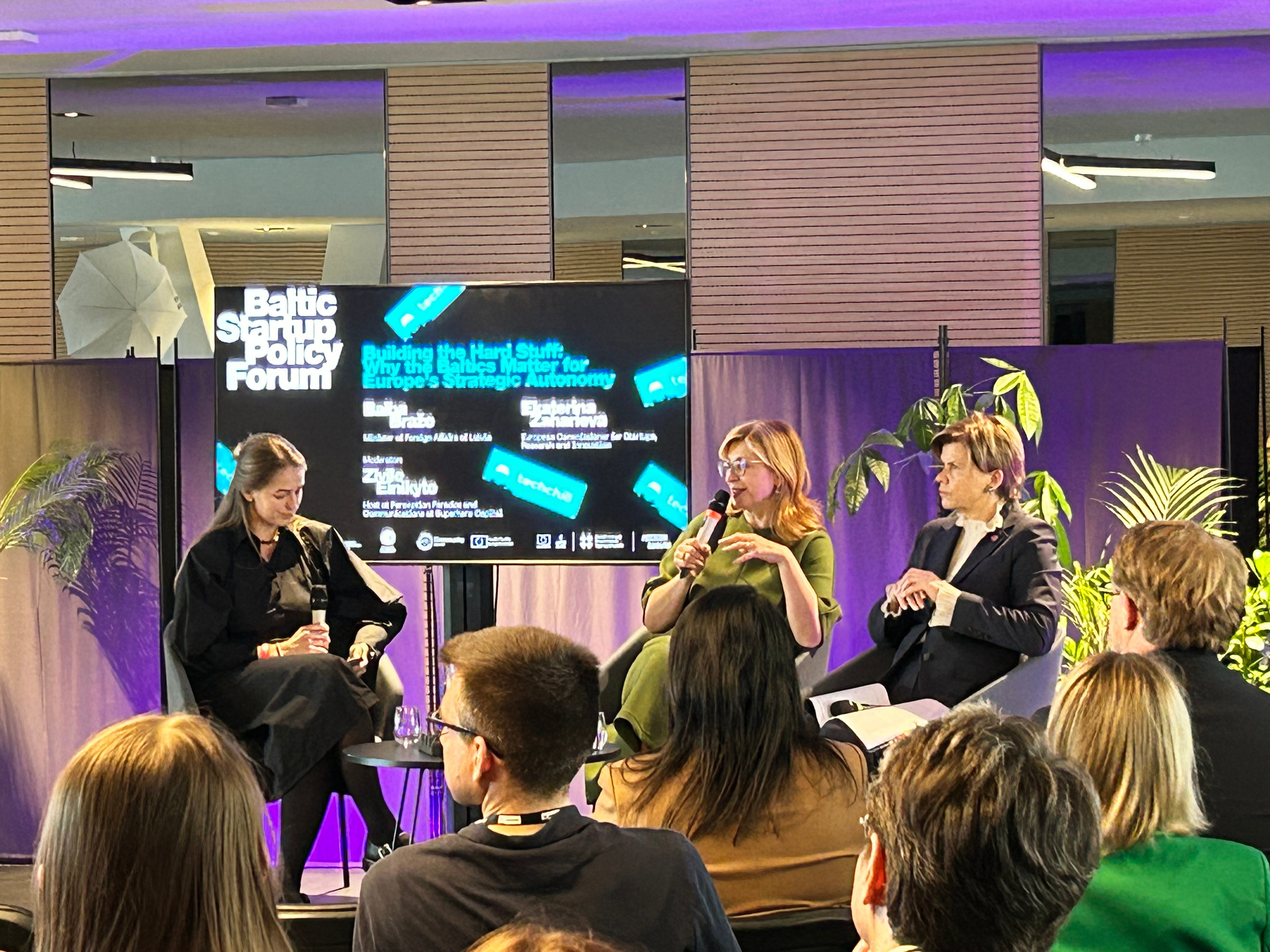
European Commissioner Ekaterina Zaharieva delivered a candid assessment of the shifting global order at the Baltic Startup Policy Forum.

RIGA — European Commissioner Zaharieva emphasised that the geopolitical landscape has fundamentally fractured, positioning the European Union not merely as a market, but as a “most reliable partner” in a world that “will not return to what it was before the war in Ukraine.”
Addressing concerns about investing in the Baltic region due to its proximity to the conflict in Ukraine, Zaharieva framed the region’s resilience as a significant attraction for global capital, rather than a liability.
Resilience Over Risk
Commissioner Zaharieva, who hails from Bulgaria, acknowledged the shared challenges faced by Eastern member states, noting her own country’s proximity to the conflict (Crimea is “like 400 kilometers across our sea”). She argued that the region’s response to the crisis has established a new standard for the continent.
“We are not going to return to what it was before the war in Ukraine,” Zaharieva stated. “But [the Baltics] show how they can adapt very fast. They are an example for all the rest of Europe.”
She highlighted the EU’s direct support for frontline innovation, noting that “many, very, very, very good Ukrainian innovators” are being supported to continue their work despite the conflict. This initiative, she argued, signals to global investors that Europe protects its innovators regardless of geographic pressure.
The European Innovation Council (EIC) Fund
To bridge the gap between early-stage success and global dominance, Zaharieva detailed the progress of the European Innovation Council (EIC) Fund. This fund is designed to prevent European unicorns from relocating to the United States for late-stage capital, leveraging resources from the European Innovation Council to spur private-sector engagement.
•Targeting deep tech: The fund specifically targets “Scale,” not “Seed,” focusing on companies that have already proven their technical viability.
•Private sector catalyst: The goal is to motivate big corporations, foundations, and institutional investors to co-invest, creating a “leverage effect.”
•Market confidence: “I really believe in the market,” Zaharieva said. “The fund will show the market that it is profitable and a good investment to support our innovators.”
A unified frontier
The Commissioner concluded by emphasising that Europe’s strength lies in its predictability. In a period where major global powers face internal and external instability, the EU’s focus on the “28th regime” and a unified capital market provides a “safe and predictable” haven.
“The rest of the world wants to deal, wants to trade, wants to make business with the European Union,” she noted, pointing to a record number of free trade agreements concluded in the past year as evidence of the bloc’s growing influence as a stable global partner.
HEDI MARDISOO: Stopping the Brain Drain: Can the 28th Regime Save European Tech?

The Draghi report, published over a year ago, finally translated Europe’s innovation reality into facts and numbers. The conclusion was sobering: Europe is years behind the United States in building large, global companies.