
FOMO.10: The biggest FOMO in Baltics?
Also this week: Estonian logistics platform wins investment offer from Latvian angels

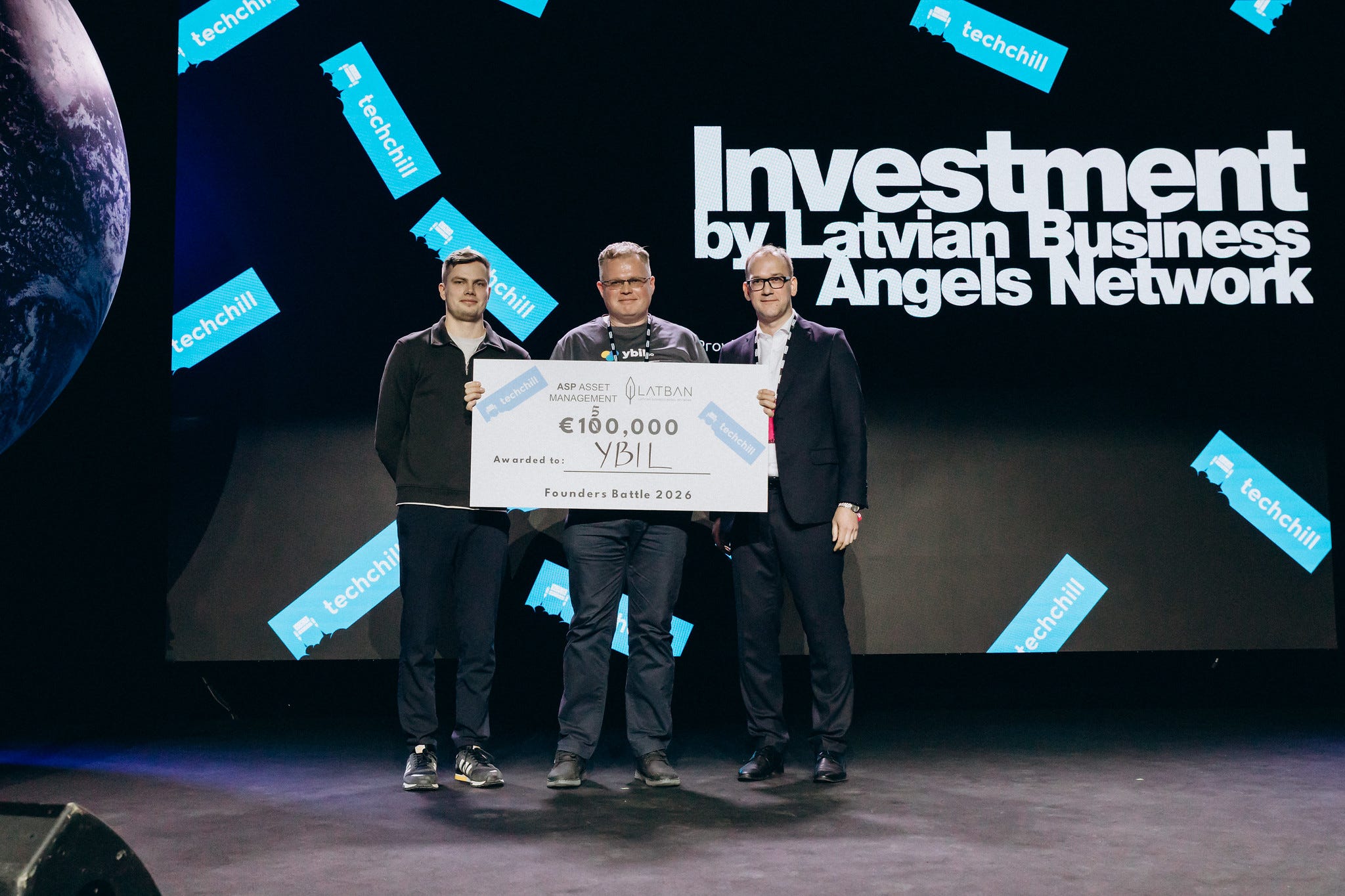
At the end of the 15th TechChill, Estonian logistics digitalisation platform Ybil, which digitises waybills, won a €150,000 investment from the Latvian Business Angels Network.
Ybil, the only Estonian team among the 20 semi-finalists, joined the long list of Estonian winners, which includes names like Salesforge, Fleetfox, and Vocal Image.
The main award of the pitching competition went to Deep Space Energy, which creates nuclear batteries for space missions. It won €10,000 in cash, €5,000 in legal and tax advice from Sorainen, a Draper University scholarship worth $12,000, and a €1,000 gift card from Carguru.
“It was a positively contrarian decision, just because of the size of the ambition that the founder is tackling,” jury member Kadi-Ingrid Lilles, Partner at Iron Wolf Capital, said in a statement.
Other investment awards went to:
Spotwise, the Latvia-based AI co-pilot for radio sales and analytics teams, received €200k investment by Outlast Fund as well as €100k investment by BADideas.fund.
Helm X, the AI-powered industrial safety helmet with automatic data capture, won a €150k investment from the Buildit 5G Fund.
TechChill brought to Riga some 2,000 participants, 300+ startups, and 250+ investors from more than 40 countries.


TechChill has most recently held satellite events in Ukraine and previously in Italy. For the first time, the Baltic Startup Policy Forum was held in parallel to the event, where policy leaders from Estonia, Latvia, and Lithuania came together to discuss startup-enabling public policies. The event was joined by European Commissioner for Startups, Research, and Innovation, Ekaterina Zaharieva.
Commissioner: Europe’s stability a shield against global volatility, Baltics an innovation beacon

RIGA — European Commissioner Zaharieva emphasised that the geopolitical landscape has fundamentally fractured, positioning the European Union not merely as a market, but as a “most reliable partner” in a world that “will not return to what it was before the war in Ukraine.”
KÄRT SIILATS: The biggest FOMO in the Baltics?
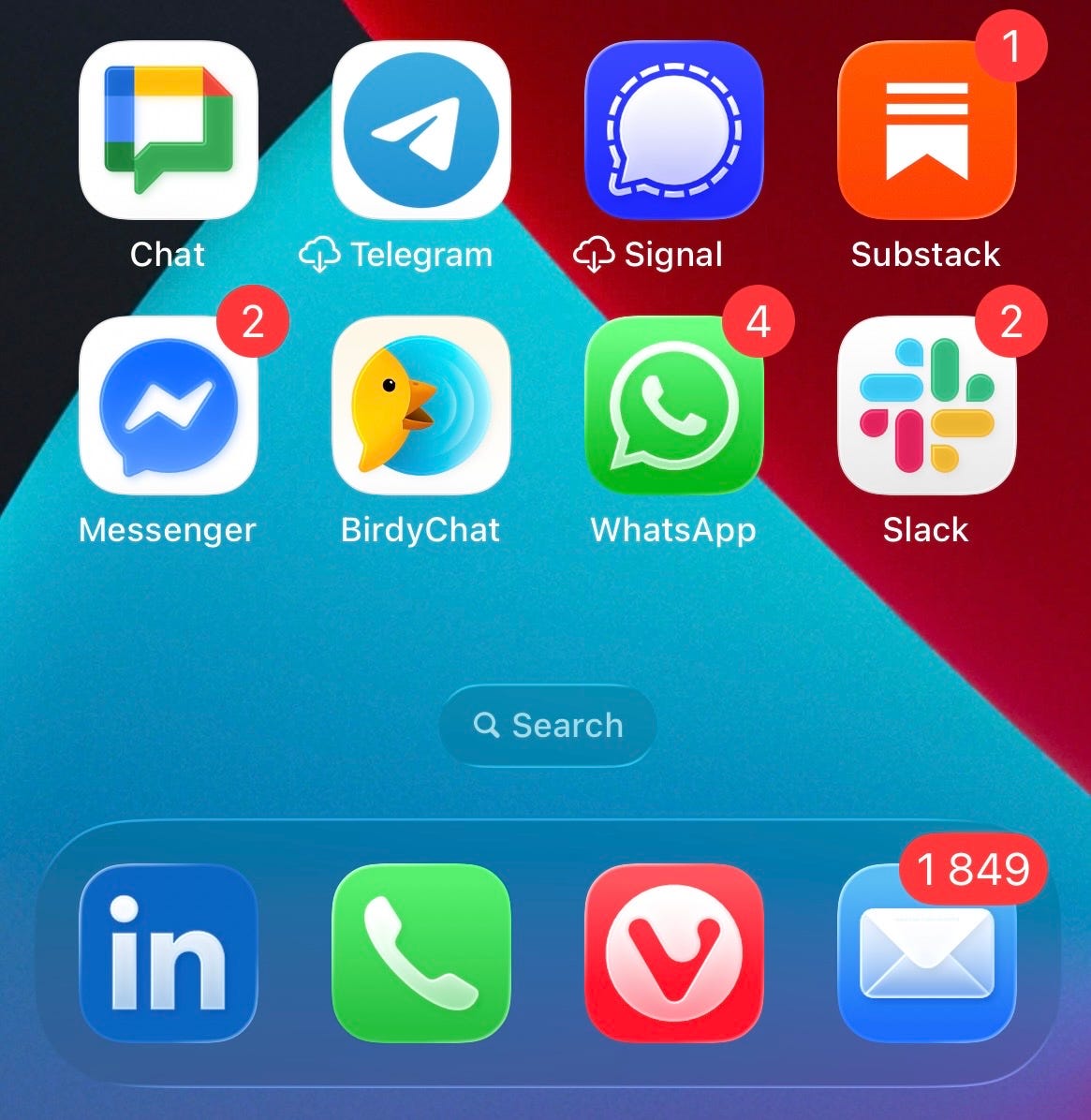
How many apps from the Baltics can say they have a 50,000-person waitlist? BirdyChat does.
It is a chat app built for professional conversations, where you can reach people by email, not by phone number. Designed for focused, meaningful exchanges between managers, builders, and collaborators. I’ve tried it myself, and it is definitely worth the wait.
So when I was in Riga for TechChill, I knew I had to sit down with Rolands Mesters — whom I’ve known since trying to assist with some aspects of Nordigen’s successful exit to GoCardless — to chat about chatting and to find out how he got there and what is different the second time around.
As he’s one of the easiest people to talk to in the ecosystem (he says, “my superpower is not coding, it’s getting others to work with me”), we of course also detoured to topics as exotic as the Elixir programming language and how his mom coded a website on Lovable (and he himself a game for his kid’s first grade class).
His mom is actually a big part of his journey – both his parents were entrepreneurs, and dinner table conversation was often about building things. He did start with an obligatory stint in the corporate world, but got his revenge when he founded a design agency and, knowing corporate budgets, charged more than he would have previously thought imaginable.
Rolands credits Anna Andersone with his first job in startups that set him on his current path. I also had the pleasure of meeting Anna at the Estonian embassy in Riga, and heard her being called ‘The Mother of Latvian Startup Ecosystem’, so it’s unsurprising that he’s managed to maintain the momentum to where he is now.
After that, Rolands started Nordigen together with Roberts Bernans, his classmate from the Stockholm School of Economics in Riga. By the time it was acquired by GoCardless in 2022, in one of the biggest Fintech exits in Latvia, from which multiple Estonian VC funds also benefited, Nordigen’s API connected to 2,300+ banks across the UK and Europe and served fintech companies and developers in 31 countries. Rolands brought his Latvian team along, and by now, GoCardless has grown to 180 people in Riga, a legacy he’s rightfully very proud of. He is stubbornly patriotic – both Nordigen and BirdyChat are established in Latvia, despite the fundraising and administrative challenges the local jurisdiction poses, which he hopes to help fix in the long run.
He says that is one of the downsides of repeat entrepreneurship, “I had forgotten how hard the hard days are and romanticised the good days.” That was partly what drove him to leave GoCardless to establish Birdy with his school friend Martins Spilners, with whom he had been building things since they were kids – Martins started coding at the age of nine.
And in a beautiful bit of startup serendipity, where the right things happen at the right time, if you’re ready for them, his favourite programming language, Elixir, which, while quite exotic among other programmers, is not only the most AI-agent-friendly, but also best suited for creating chat apps. This is also why their eight-person team now includes an Estonian – the pool of Elixir developers in Latvia is simply too small. But Rolands can find positives even in that – he says they’re not competing with other startups for developers, and the language affinity self-selects for truly passionate and dedicated developers.

I would argue that in addition to Rolands’s sunny personality and infectious enthusiasm, the superpower that makes him eminently investable is also his ability to spot revolutions. Nordigen took advantage of the open banking revolution and Birdy is similarly taking advantage of the European laws that force the biggest messaging apps to have interoperability with others – you can chat with Birdy users directly from your WhatsApp.
Leaving GoCardless to start BirdyChat, of course, also sent a very strong signal to VCs about his dedication and belief in the new opportunity. So when he posted on LinkedIn that he was working on something new, he was inundated with VC approaches. Rolands says the benefit of repeat entrepreneurship is that he gets to choose people he already knows and has invested in his company before. But also that people know his name, and it opens doors that were closed before. As he puts it, he’s “milking the second time founder aura for all that it’s worth.” He says fundraising still wasn’t easy, VCs think everything that is truly new is crazy (can’t argue with that), but he did end up with quite a dream cap table.
For BirdyChat, the next challenge is to reach the kind of network density that would keep them on the front screens of smartphones everywhere, and, as a first step on that journey, they are inviting the Estonians in soon. I would definitely recommend that other founders sign up for the waitlist for a chance to follow Rolands’ example and use Birdy to manage their own fundraising chats, find ways to use those chats to improve their product, and use it as part of their fundraising wherever possible.
More stories from TechChill:
Coming next: Air as a Service

RIGA - In the startup world, the most enduring founders often build solutions for problems that have quietly annoyed them for decades. For Ivo Remmelg, that “annoying problem” was literally the air he was breathing.
Energy and AI-software shine in Baltic deeptech scene

RIGA - According to the Baltic Deep Tech Report 2025, science-driven enterprises captured half of all venture capital raised in the region last year, signaling a “maturation phase” for Estonia, Latvia, and Lithuania.
MOVES
Skeleton named Kimmo Rauma as an Independent Member of its Board of Directors as it continues to ramp up its manufacturing and engineering capabilities in Finland.
“Dr Rauma brings hands-on experience in scaling industrial technology businesses, building international footprints, and commercialising advanced electrification solutions,” Skeleton said in a statement.
THE END OF THE ROAD
Tuul Mobility OÜ, the e-scooter fleet that once stood as a national symbol of the micromobility boom, has officially filed for bankruptcy. The move comes after the company admitted it cannot meet an interest payment on its 10% bonds due this Sunday, March 29, 2026.
In a somber statement to the stock exchange, founder Kristjan Maruste addressed the collapse of the venture:
“I sincerely regret and apologise to investors that, despite our team’s efforts, we were unable to successfully complete this ride.”
The downfall of Tuul is a textbook case of market timing and shifting economic tides:
The bond trap: Tuul raised expansion capital through a bond issuance in early 2022, right as the e-scooter hype peaked. However, aggressive oversupply and a sharp rise in interest rates soon turned the tide against the local player.
Failed salvage operations: Late last year, Tuul attempted to stem its losses by selling its remaining hardware and intellectual property to the Latvian firm Ride SIA. Unfortunately, the proceeds from the sale fell short of covering the €3.25 million outstanding bond obligation.
The comodule crisis: The original rescue plan relied on a sales process for the parent company, Comodule OÜ, which serves as the bond’s guarantor. When that sale failed to materialise, Comodule informed Tuul it could no longer support the interest payments from its regular cash flow, forcing Comodule itself into restructuring.