
The Liquid Macro: Why ‘unsexy’ water infrastructure is the next great defensive asset
As defence tech dominates the headlines, smart capital is moving toward the $22 trillion climate adaptation gap—starting with the pipes, sensors, and generators securing our urban resilience.

While some yield-hungry investors have a major FOMO doomscrolling defence tech, quietly asking themselves if they are late to the “high risk/ high return party”, then don’t - we got you - the awkward truth is that the truly underrated asset class is the one you only notice when it disappears.
Last week, at his speech at the Startup Awards Gala, Ragnar Sass shared that the unsexy investments in his portfolio tend to be the most profitable ones in the long run.
“Water-related challenges” are often seen as unsexy. Right up until they turn into a city-wide emergency.
Tallinn got a reminder of that on New Year’s Eve, when water pressure dropped in parts of the city, leaving many homes and restaurants without water for hours. A friend who was hosting the hottest event in Old Town couldn’t wash her hair and had to close the event, watching about 15K in ticket revenue and unsold drinks go down the drain (pun intended!).
Local utility Tallinna Vesi explained that it was driven by frazil ice on Lake Ülemiste, which repeatedly formed an ice barrier in front of the intake pipe just as consumption spiked for the holiday. Luckily, everything was back to normal by the early morning hours of January 1.
This is the clean water story in one scene. Infrastructure and urban resilience are both hiding inside a glass you usually fill without thinking.
A banker who talks about water?
A couple of months ago at Impact Day, I met Christopher Flensborg, Head of SEB Water. “The Water Guy,” as he introduces himself jokingly.
SEB created the unit in 2024 and describes its mission in plain language: to “identify water-related challenges and understand what they mean for clients,” and to build “advisory capabilities and banking solutions.”
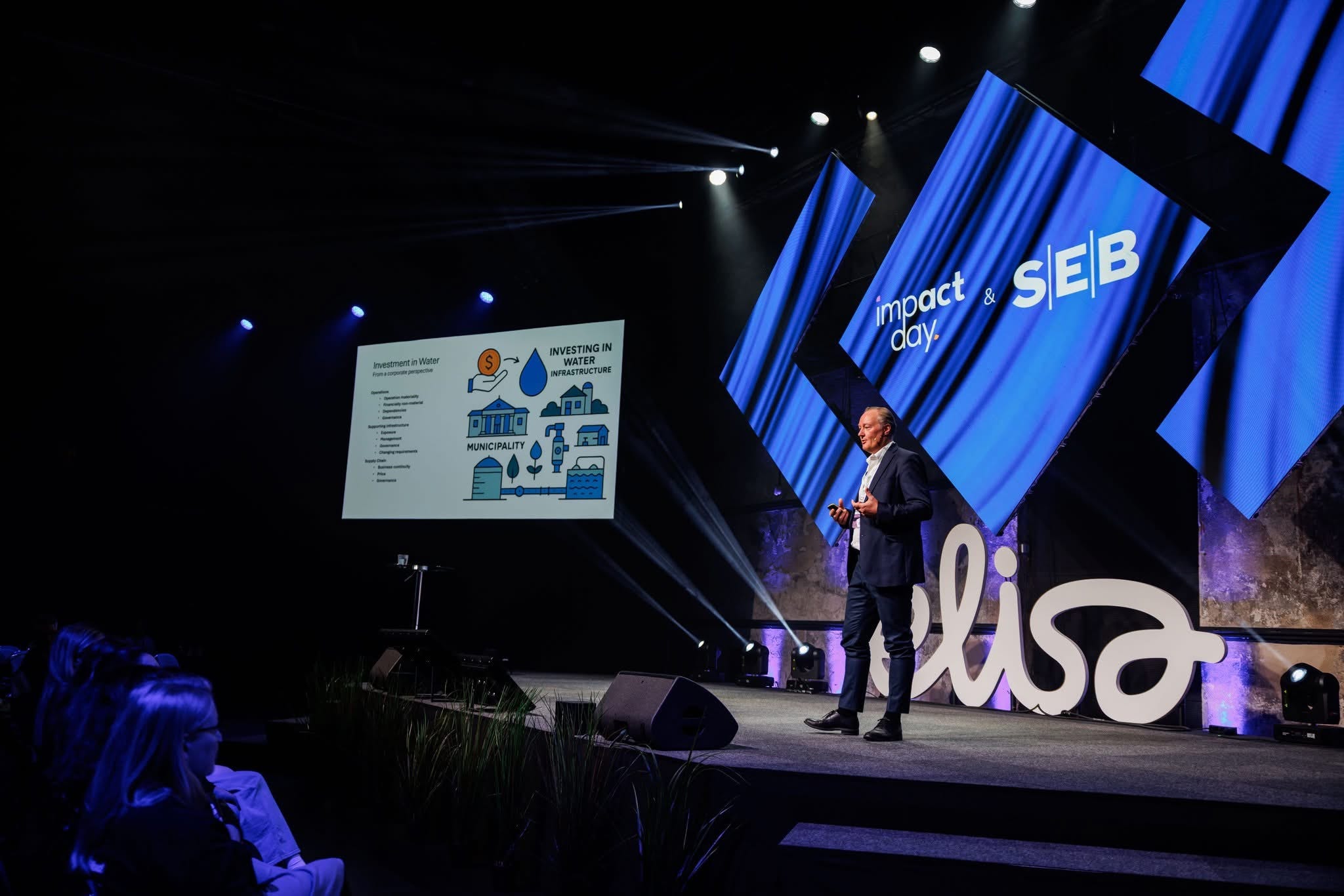
That is the SEB representative speaking, and it matters because it shows how a big bank frames the topic internally.
Flensborg keeps widening the frame in our conversation. Water is a system. Surface water, groundwater, pipes, plants, urban life, industry, food, and insurance. Treat it like a single line item, and it will come back later as a shock.
Four ways water fails
SEB has a simple structure that makes the mess easier to hold. In its own words, SEB groups today’s water challenge into “too much water floods,” “too little water scarcity,” “too dirty water pollution,” and “too old water outdated infrastructure.”
The brutal part is that all four can hit the same region in the same decade. Flood one season and scarcity the next. Pollution scares that wipe out trust overnight.
Infrastructure built for a calmer climate that now fails under stress.
Why a bank cares about water
SEB is direct about the scale problem. Flensborg points to OECD and World Bank estimates and says 22,600 billion dollars needs to be raised over the next 25 years to meet water-related challenges. Those numbers are SEB’s chosen framing, and the point is not the decimals. The point is that the finance system is being told to move a lot of capital into water, and it has to happen across decades, not quarters.
He also gives concrete examples to show this is not a theory. SEB, having worked with Blue Bonds for over a decade, highlights the refinancing of water infrastructure in the Netherlands at around SEK 100 billion (that’s 9.45 billion euros!).
The missing ingredient is speed, scale, and the ability to execute in places where governance and procurement move slowly.
Why does water belong in the same sentence as inflation?
Flensborg’s thesis is simple - water is now a macro story.
There is a simple rule for judging how big a problem is becoming. When it reaches pop culture, it has already left the “expert only” phase. Water has been sitting there for years in long-form storytelling. It shows up as geopolitics, as daily life, and as the slow grind behind migration and instability. Then it starts showing up where founders actually listen. Podcasts.
FOMO editor Tarmo’s NatureBacked Podcast keeps returning to water — a signal in itself. When a theme becomes recurring content, it usually means people have stopped treating it like a moral topic and started treating it like a buildable one.
When water is missing, polluted, or arriving in extremes, the costs show up everywhere. Health and productivity, food prices, and industrial output. Not to mention AI!
Municipal budgets, insurance claims, and political stability. You do not need a PhD to see how water shocks can travel straight into price shocks.
Then he goes straight for the unglamorous part — efficiency, leakage, and governance.
Fixing waste in old systems can be cheaper than building a new supply. It can also be attractive for serious infrastructure money because the upside is steady and the demand is structural.
His sharper point is governance debt. We built critical infrastructure, outsourced big parts of it, and froze the governance model in time. Contracts often reflect a different era, with a different climate and risk profile, meaning the urgency changes, but the paperwork does not.
What companies in the Baltics can do this year?
When I asked what is practical for companies in our region to do, he said two things.
First, manage your water dependence like a real operational risk. Map it. Know where water is critical in production, cooling, cleaning, agriculture inputs, and your supply chain. If you can guarantee stable water access when others cannot, you become a superstar overnight.
Second, treat water solutions as a business line. Circularity will grow, meaning reuse and recycling, and smarter loops inside factories and cities. Growth will also be in water-as-a-service models (WaaS), where companies buy outcomes and resilience rather than owning and operating every piece of hardware themselves.
If you operate in an area that floods and the municipality cannot address quickly enough, you will still need drainage, pumps, storage, pipes, sensors, and maintenance. Many firms will prefer to pay someone else to run it. That is a market.
Aquaria enters the chat
If you want a clean example of what water innovation looks like in founder language, listen to the NatureBacked episode with Aquaria.
Aquaria builds atmospheric water generators to produce clean drinking water from the air. The appeal is obvious. If you can make water locally, you reduce reliance on pipes and large centralised systems, and you can bring supply closer to demand in a world where disruptions are becoming normal.
You do not need to agree with every big claim to see the signal. People are building for a future where water becomes more distributed, more engineered, and more investable.
The bottleneck – water talent
Flensborg spoke on talent almost like a warning. He expects a shortage of water engineers, operators, and planners as adaptation projects scale. Build out takes time, permitting takes time, and of course, training takes time. That creates a backlog that can last for decades.
If you are a young builder looking for a problem space that will still matter after the next hype cycle burns out, water is sitting there quietly waiting.
At one point, the room shifted. He stopped talking to me like a banker and spoke like a human. He who has always wanted to become a banker has a personal reason, being the Water Guy.
“This is not about me drinking tap,” he said, and “it’s not about you having less bottled water. We all have a responsibility.”
Then he told me why he stays in this work. At one point, he went through two brain operations, and when he came out of it, he made a promise: He would do capitalism but still do something for the environment, make his work meaningful.
I asked if I could write it down and share that story at one point. He said yes.
I have heard plenty of polished “ driven by purpose lines” over the years. This was different. It was quiet, and it explained the engine behind his obsession with water. It turned the topic from an investment theme into something bigger.
Water is the ultimate cross-sector asset. It touches surface water and groundwater, infrastructure, cities, factories, farms, and insurance books. You can split it into spreadsheets, and it will still appear everywhere. So, investors, while some of you are scared of missing the next drone deal, you do not have to pick a side.
Drones are necessary, and pipes are necessary.
The difference is that pipes are still weirdly overlooked.