
The term sheet wedding: Why startup pitching finals are won before the smoke machine starts
As Latitude59 prepares its 2026 stage, Baltic angel networks are focused on ensuring that "Hollywood" moments translate into long-term equity deals


While founders sweat over slide decks for Latitude59, the reality of the sector’s premier pitching competitions is often decided in backrooms long before the smoke machine hits the stage.
“At the stage where we invest, the nature of the startup is much more important than the business,” says Lauri Antalainen, President of Estonian Business Angels Network (EstBAN).
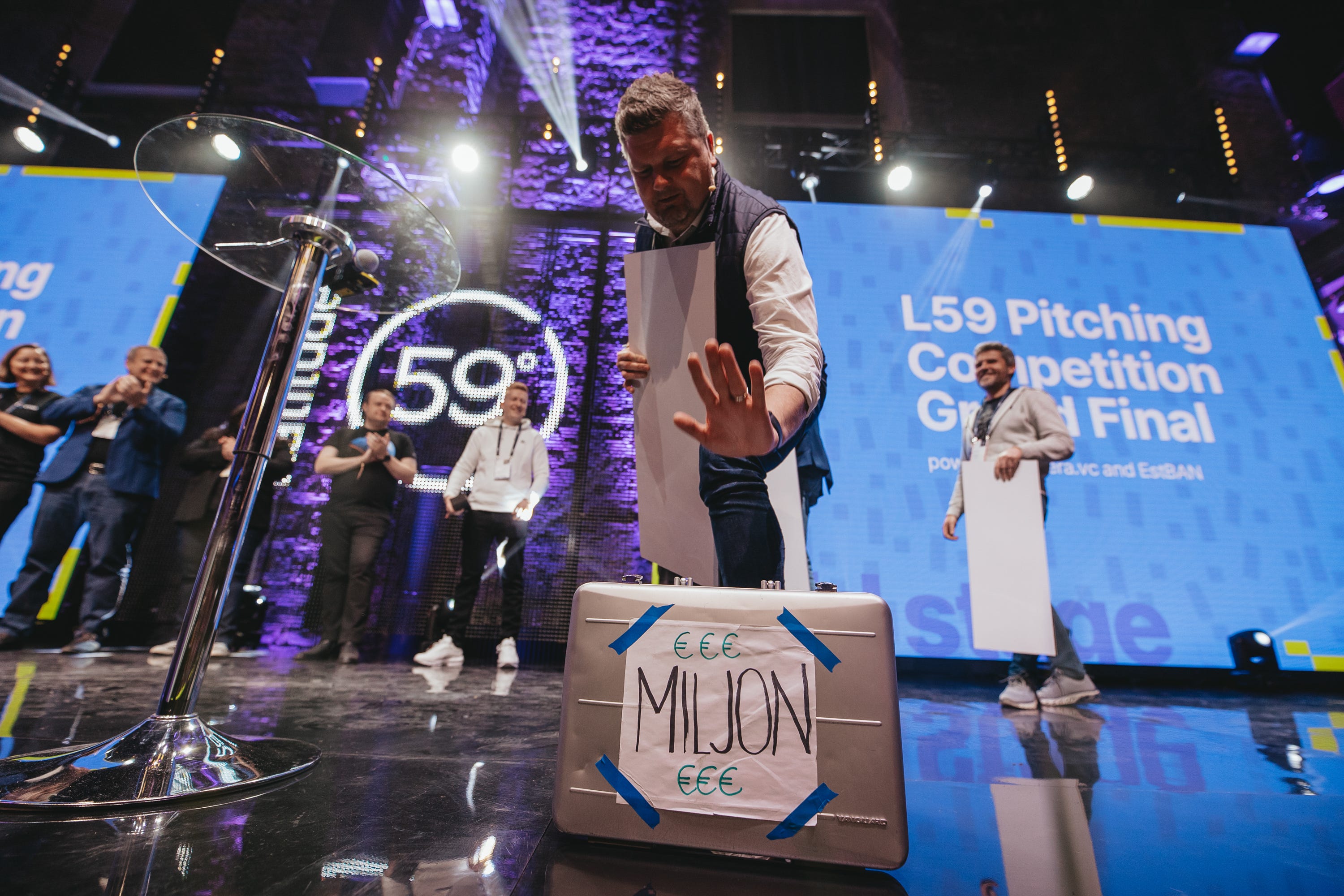
No aspiring entrepreneur ever glows with as much radiance as on the day they are handed a cheque almost as big as they are, with a few lovely zeroes written across its front. This Hollywood game-show flair is part of the act, helping to gather crowds in the final hours of conferences.
In reality, these competitions are marketing events designed to bring attention to all parties involved — a process Madis Lehtmets, managing director of EstVCA, calls “completely logical”.
The hunger games of funding
Despite the bright lights, the idea that winners receive actual cheques is a fantasy. It’s an investment like any other, but it looks different. A bit like a scene from The Hunger Games, where mentors scramble to convince wealthy sponsors to send life-saving gifts to contestants — only in this case, the contestant is trying to scale a deep-tech app.
Not everything is agreed upon two months before the event when we meet with Jana Saastamoinen, managing director of EstBAN. “The negotiations are ongoing,” she says. “We’ve promised up to €300,000 between the three BANs, but how much each BAN’s angels will contribute will be determined by the day of the finals”. This inherent uncertainty is why PR materials are deliberately vague.
Three top performers, post-win
Fractory (2018). Since its €170k win, Fractory has raised over €15 million and has reported an annual turnover of over €10 million since 2022.
Cino (2023). After winning a €500k syndicate, the bill-splitting startup parlayed that visibility into a €3.5 million seed round led by Balderton Capital.
ÄIO Tech (2023) Despite receiving the smallest split of the record 2023 prize (€150k), ÄIO utilised the credibility to raise €5.6m by early 2025.
Lessons from the North
The caution is built into the competition model based on historical lessons. In the early years of the Slush pitching competition, some winning startups famously turned down investment offers after the cameras stopped rolling.
The resulting PR nightmare taught regional organisers —including those at Latitude59 — a harsh lesson: the ‘marriage’ must be brokered before the wedding ceremony.
To avoid such public fallout, today’s organisers work to ensure that startups agree to the terms of the investment deal (a term sheet in industry slang) before any winner is announced. “You can’t announce a winner and then later find out that they actually had completely different term sheets in mind,” Antalainen notes.
However, the unvarnished truth includes the friction of the aftermath: Not all competitions are created equal. A Startup Fair 2025 pitching competition in Lithuania promised tens of millions in prizes — more than any fund in the country could invest, as an investor pointed out. We are looking closely for the results.
Networks perform “at least the bare minimum” due diligence before the event, but the heavy lifting of formalising equity and investment vehicles happens in the weeks following the show. It will likely take many months before your winnings hit the account,
While success stories like Nanordica Medical used their €150,000 ‘win’ to secure major grants and complete clinical trials, others face harsher realities. Ukrainian startup Ender Turing received €250,000 at Latitude59, but unfortunately, due to the war's impact on the business, it had to rebuild.
The reality check: When the "Winner’s curse" hits
VideoCV.io (2019). Secured €225k syndicate; struggled against integrated HR giants. Founders recently announced a wind-down.
Vumonic Datalabs (2021) €150k winner. 2025 revenues of Estonian mother company remained at €76k against a €185k loss; currently a niche play in India.
Zelos Team Management (2019). Won €250k syndicate. Despite a high-rated app, it has remained in a "scrappy" seed stage for 7 years without broader market capture.
Looking ahead
For those seeking to navigate this gauntlet, the path to the 2026 ‘New Nordics’ prize follows a strict, non-negotiable timeline:
April 15: Deadline for submissions.
April 29: Announcement of the Top 30 companies.
May 4-8: The crucial semi-finals.
May 21-22: The final show at Latitude59’s steampunk-inspired Tallinn Creative Hub.
As Antalainen points out, even a win doesn’t guarantee universal backing; typically, ten to fifteen percent of investors in a syndicate will still choose not to follow the lead into the deal. In this world, the pitch gets you the meeting.
 | A guest post by
|