
While the U.S. Partied in 2025 Like It Was 2021, Estonia ... Built Factories?
The 2025 VC Reality Check from Dealroom

TALLINN - If you only looked at the global headlines, 2025 was the year the party returned. According to the latest Dealroom 2025/2026 Global Tech & VC Wrapped report, global venture capital investment surged to $434 billion, a 27% year-on-year increase.
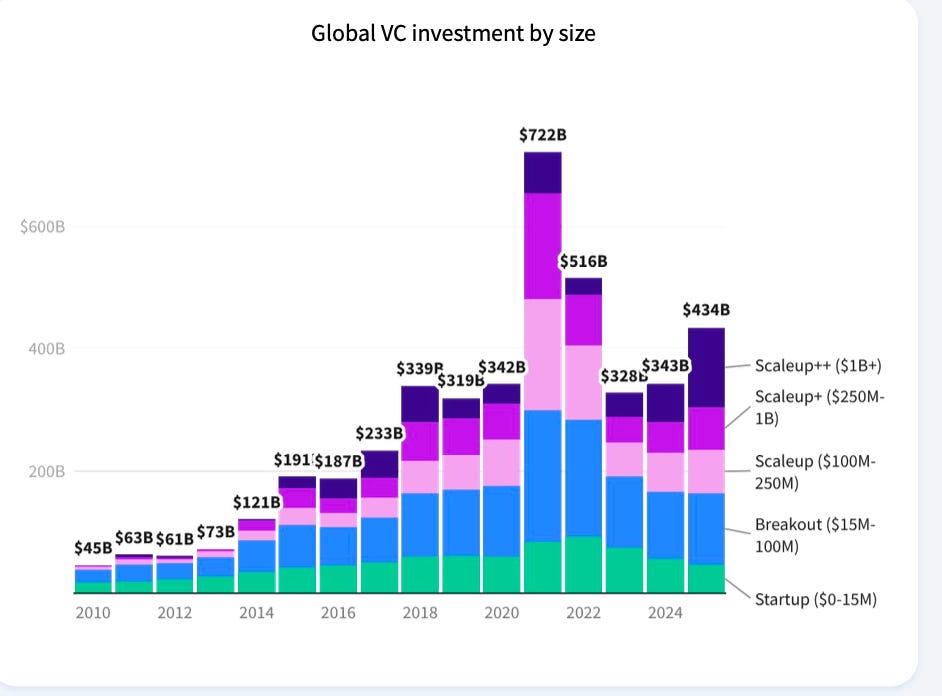
The “crypto winter” and “SaaS slump” narratives were buried under an avalanche of AI capital.
But for those of us on the ground in Tallinn, looking at our own cap tables and deal flow, that global champagne popping sounds distant.
Estonia didn’t get the full invite to the 2025 rebound party — at least, not the one happening in San Francisco. Instead, while the Bay Area inhaled nearly half of the world’s scaleup capital, Estonia quietly pivoted to a harder, grittier reality: building atoms, not just bits.
The “AI Gravity Well”
The report describes a phenomenon that explains exactly why local deal flow remained tight despite the global boom. Dealroom calls it the “AI gravity well.”
“AI became the gravity well: $198B went into AI -- almost half of all VC – pulling talent, capital, and outcomes into fewer, bigger platforms.”
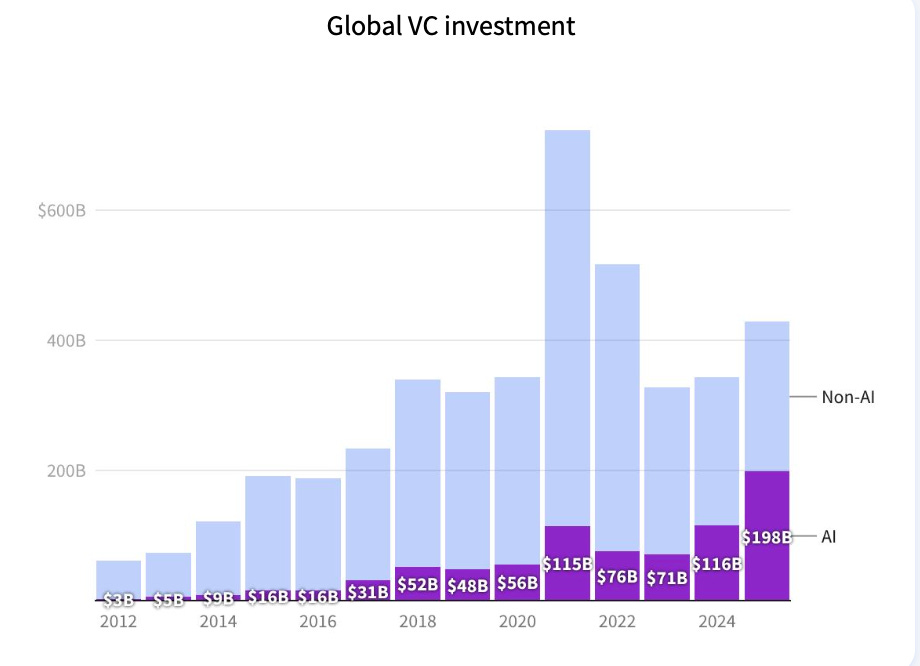
This concentration is quite staggering. The U.S. captured 65% of global VC investment, largely because the “mega-round era is back”. But these mega-rounds (deals over $100M) were almost exclusively reserved for American AI infrastructure and foundation models.
For a software-heavy ecosystem like Estonia, this created a vacuum. The “New Palo Alto” supercluster (London, Paris, Amsterdam) managed to secure $15.2B in scaleup capital, but the capital trickle-down to the Baltics was practically non-existent for generic B2B SaaS.
Total investments in Estonian startups slipped another 11% to 319 million euros, to the lowest level since 2019, according to data collected by the community.
Estonia’s Play: “Hard Tech” and Resilience
However, the data reveals where Estonia’s new lane lies. If we can’t out-spend OpenAI, we out-build them in the physical world.
The report highlights a critical shift that aligns perfectly with recent local wins, such as Skeleton Technologies’ long-awaited €220M factory opening in Leipzig and Starship’s $50M C-round in the fall.
“Hard tech returns to centre stage... startups build atoms — materials, molecules, medicines, hardware — not just bits.”
While the U.S. dominates software and AI models, Europe is finding its footing in industrial depth. This “Great Re-Wiring of Tech” suggests that Estonia’s future might not be in another photo-sharing app, but in deep tech and defence sectors that moved “from niche to priority” in 2025.
The Exit Elephant in the Room
Perhaps the most reassuring data for local investors holding their breath for liquidity is the state of the exit market. 2025 saw a massive unlocking of M&A activity.
“Liquidity reopened through M&A: first-time M&A exits hit a record $131B, while IPOs improved but remain far below the 2021 bonanza.”
This is the context Bolt is staring down as it preps for its highly anticipated IPO. And it’s not only Bolt, but the backlog is massive. Dealroom estimates there is currently “$7 trillion in combined value waiting for wider public windows”.
For Bolt, and the “Mafia” of employees waiting to recycle that capital back into the Estonian ecosystem, the window is cracking open, but it’s narrow. The report notes that IPOs remain “selective”. The market is rewarding “fundamentals over frothy entry multiples”.
The 2026 Outlook
So, what does this mean for the Estonian founder in 2026?
Forget the Seed Hype: The “tourism capital” hasn’t returned. Early-stage funding remains “disciplined,” reshaped by “post-2021 scar tissue”. You need revenue, not just a pitch deck.
Defense is Strategic: With the geopolitical reality in our backyard, defense tech is no longer taboo – it’s “strategic infrastructure”.
The Bar is Higher: The days of raising on a promise are gone. The “thoroughbreds” – companies with $100M+ revenue – are the new heroes.
As Dealroom summarises: “AI isn’t ‘over’ - it’s industrialising”.
For Estonia, 2026 won’t be about chasing the LLM hype train. It will be about integrating that intelligence into the physical machinery, defence systems, and energy grids that Europe desperately needs.
The party is happening, but the dress code has changed from hoodies to helmets.